Love this? Save it for later!
Share the inspiration with your friends
I had avoided baking Pan de Muerto for years. Honestly, it felt like a project I’d start on a Friday night and finish sometime the following Tuesday. The whole process seemed so sacred and specific—I worried I’d mess it up and serve my family something that tasted like dry, sad bread on a night when we were supposed to be celebrating life. Then, last October, my neighbor Carmen knocked on my door holding a piece wrapped in a paper towel. “You have to try this,” she said, practically shoving it into my hands. It was still warm, dusted with sugar, and smelled like orange blossoms and butter. I took a bite, and I swear, I just stood there in my doorway, chewing in silence. It was soft, tender, and not at all the dense, dry loaf I had built up in my head. I asked for the recipe. She laughed and said, “There is no recipe. You just feel it.” That was not helpful, obviously. So I spent the next week obsessively testing versions, trying to capture that exact texture and flavor. I burned the first batch. The second batch looked like a deflated football. But the third batch? That one made me close my eyes. This is that version. It is the one I now make every Día de Muertos, and it comes together in a single afternoon—not a whole weekend. If you have been putting this off because it seems intimidating, I get it. Let me show you how simple it can be.
Why You’ll Love This Recipe
This Pan de Muerto is designed for the busy home baker. You don’t need a stand mixer or a pastry degree to pull this off. The dough is forgiving, the glaze is foolproof, and the whole thing comes together in about three hours—most of which is hands-off rising time.
- Quick & Easy : Active prep is only about 20 minutes. The rest is just letting the yeast do its job while you clean up the kitchen or help the kids with homework.
- Simple Ingredients : You likely have flour, butter, eggs, and sugar in your pantry right now. The orange blossom water is the only specialty item, and you can find it at most grocery stores or online.
- Perfect for Día de Muertos : This bread is a centerpiece for the ofrenda, but it’s also wonderful for a cozy fall brunch or a weeknight treat with coffee.
- Crowd-Pleaser : My kids, who usually turn their noses up at “weird” bread, devour this. The orange glaze is sweet but not cloying, and the texture is like a brioche—soft and pillowy.
- Unbelievably Delicious : The combination of orange zest in the dough and the floral orange blossom glaze is pure comfort. It tastes like a hug from someone who loves you.
What makes this recipe different from the rest? It’s the texture. I spent a lot of time testing hydration levels to make sure the dough stays soft for days, not just hours. Plus, I use a tangzhong-style starter (a simple flour-and-water paste) that keeps the bread incredibly moist. It is not just another version—it is the one that finally made me stop being scared of yeasted doughs.
This recipe is the kind that makes you close your eyes after the first bite. It is comfort food reimagined—faster, simpler, but with the same soul-soothing satisfaction. Perfect for impressing your family without stress, or turning a simple Tuesday night into something memorable.
What Ingredients You Will Need
This recipe uses simple, wholesome ingredients to deliver a soft, aromatic bread that feels special without requiring a trip to a specialty store. Most of these are pantry staples, so you can probably start mixing right now.
- All-purpose flour (3 ½ cups / 440g) – I use King Arthur Flour for consistent protein content. Don’t substitute bread flour here; it will make the bread too chewy.
- Active dry yeast (2 ¼ teaspoons / one ¼-ounce packet) – I prefer Red Star or Fleischmann’s. Make sure your yeast is fresh—check the expiration date!
- Whole milk (½ cup / 120ml, warm) – Warm it to about 110°F. Too hot will kill the yeast; too cold will slow it down. If you are dairy-free, oat milk works well here.
- Granulated sugar (½ cup / 100g) – This feeds the yeast and adds sweetness. Do not reduce it; the sugar is crucial for the soft texture.
- Unsalted butter (6 tablespoons / 85g, softened) – I use Kerrygold for its rich flavor. Let it sit out for an hour before starting.
- Large eggs (3, room temperature) – Cold eggs will seize the dough. If you forgot to take them out, place them in a bowl of warm water for 5 minutes.
- Orange zest (2 tablespoons, from about 2 large oranges) – This is the backbone of the flavor. Use a microplane for the finest zest—avoid the white pith, which is bitter.
- Vanilla extract (1 teaspoon) – Pure vanilla, not imitation. It rounds out the citrus.
- Salt (1 teaspoon) – Fine sea salt is best. It balances the sweetness and strengthens the gluten.
- For the tangzhong starter : 3 tablespoons (25g) all-purpose flour + ½ cup (120ml) water. This paste keeps the bread soft for days.
- For the orange blossom glaze : 1 cup (120g) powdered sugar, 2 tablespoons orange blossom water, 1 tablespoon fresh orange juice. Adjust consistency with more juice or sugar as needed.
- For decoration : Extra granulated sugar or coarse sanding sugar for sprinkling after glazing.
Ingredient selection tip : Look for orange blossom water in the international aisle or near the cocktail mixers. Nielsen-Massey makes a good one. If you can only find rose water, use it—it will taste different but still lovely.
Equipment Needed
You don’t need a fancy kitchen to make this bread. A few basic tools will do the job just fine.
- Large mixing bowl – Glass or stainless steel works best. Avoid plastic, which can hold onto odors.
- Wooden spoon or dough whisk – For the initial mixing. I prefer a Danish dough whisk—it cuts through sticky dough like magic.
- Stand mixer with dough hook (optional) – If you have one, it makes kneading easier. But you can absolutely knead by hand. I did it for years.
- Baking sheet – A half-sheet pan (18×13 inches) lined with parchment paper. No greasing needed.
- Plastic wrap or a clean kitchen towel – For covering the dough while it rises. A damp towel works better in dry climates.
- Microplane or fine grater – For zesting the oranges. A box grater works in a pinch, but you will get bigger pieces.
- Pastry brush – For applying the glaze. A silicone brush is easiest to clean.
- Cooling rack – Essential for letting the bread cool evenly. If you don’t have one, use the wire rack from your oven.
Budget-friendly tip : If you do not have a stand mixer, knead the dough by hand for 10-12 minutes. It is a great arm workout, and you will feel more connected to the bread.
Preparation Method
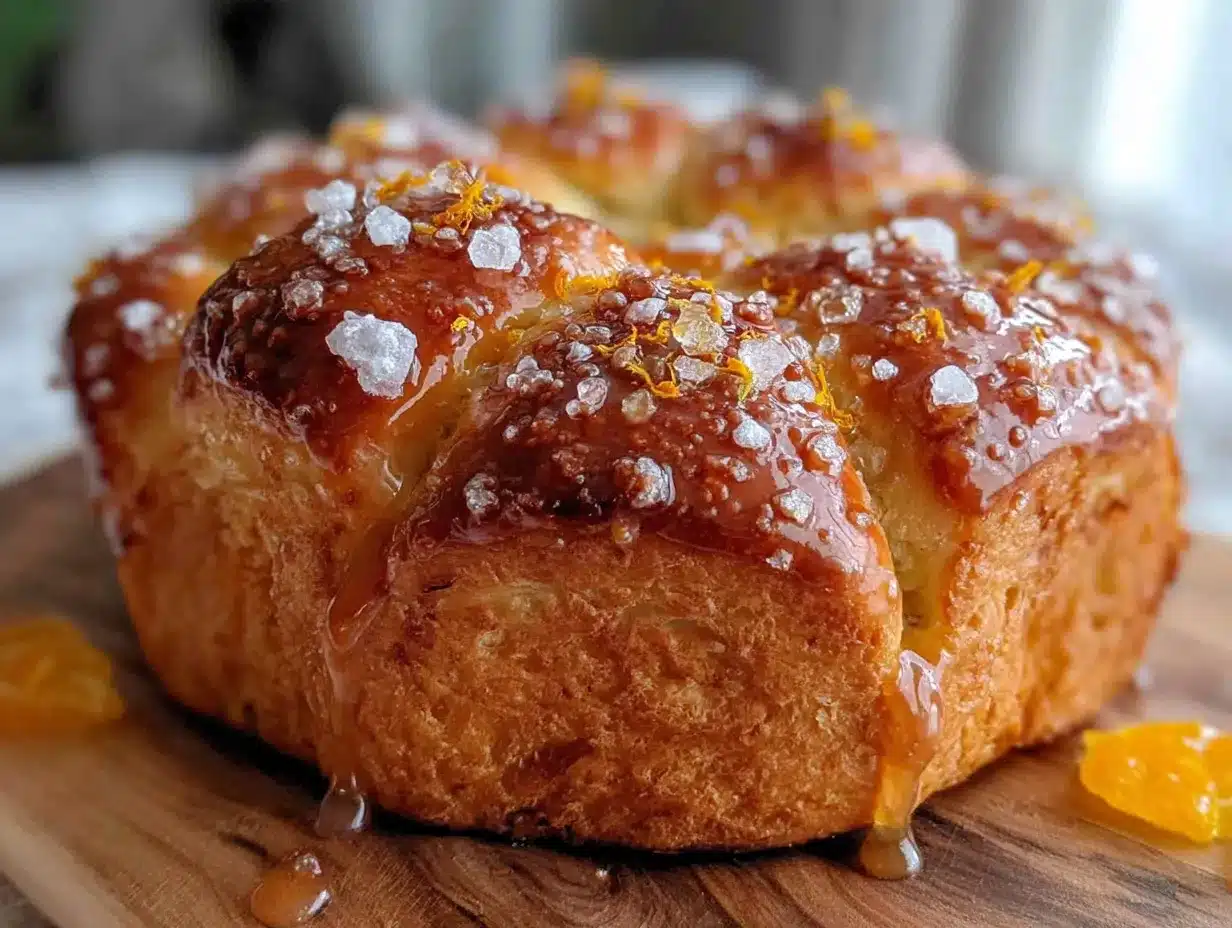
Let’s get to the fun part. Follow these steps, and you will have a beautiful, fragrant loaf on your table in about three hours.
-
Make the tangzhong starter – In a small saucepan, whisk together 3 tablespoons flour and ½ cup water. Cook over medium heat, stirring constantly, until it forms a thick paste (about 2 minutes). It should look like wallpaper paste. Remove from heat and let it cool to room temperature. (This step takes 5 minutes, but it is the secret to a super-soft bread.)
-
Activate the yeast – In a small bowl, combine the warm milk, 1 tablespoon of the sugar, and the yeast. Stir gently and let it sit for 5-10 minutes until it becomes foamy. If it does not foam, your yeast is dead—start over with fresh yeast.
-
Mix the dough – In a large bowl (or the bowl of your stand mixer), whisk together the remaining sugar, flour, and salt. Add the cooled tangzhong, foamy yeast mixture, eggs, softened butter, orange zest, and vanilla. Stir with a wooden spoon until a shaggy dough forms. It will look messy—that is normal.
-
Knead the dough – Turn the dough out onto a lightly floured surface. Knead for 10-12 minutes (or use your stand mixer with the dough hook on medium-low for 8 minutes). The dough should be smooth, elastic, and slightly tacky but not sticky. If it is sticking to your hands like crazy, add a tablespoon of flour at a time. If it feels dry, add a teaspoon of water. You will know it is ready when you can stretch a small piece into a thin windowpane without it tearing.
-
First rise – Place the dough in a lightly oiled bowl, turning to coat. Cover tightly with plastic wrap and let it rise in a warm spot for 1-1.5 hours, until doubled in size. I set my oven to the “proof” setting (or just turn the light on) and place the bowl inside. If your kitchen is cold, it might take longer—be patient.
-
Shape the dough – Punch down the dough gently to release the air. Turn it out onto a clean surface. Cut off about ¼ of the dough and set it aside. Shape the larger piece into a round ball by tucking the edges under. Place it on the prepared baking sheet.
-
Form the bones and top piece – Divide the reserved dough into 4 equal pieces for the “bones” and 1 small piece for the top knob. Roll each of the 4 pieces into ropes about 6 inches long. Place them on top of the round loaf in a cross pattern (two ropes crossing in the center, forming an X). Roll the small piece into a ball and place it in the center where the ropes cross. This represents a skull and bones—the traditional look.
-
Second rise – Cover the shaped loaf loosely with a clean towel and let it rise for 45 minutes to 1 hour, until puffy and almost doubled. It should look pillowy.
-
Preheat and bake – About 20 minutes before the second rise is done, preheat your oven to 350°F (175°C). Bake the bread for 25-30 minutes, until the top is golden brown and the internal temperature reaches 190°F (88°C). If the top is browning too fast, tent it loosely with foil after 15 minutes.
-
Make the glaze – While the bread cools, whisk together the powdered sugar, orange blossom water, and orange juice until smooth. It should be thick but drizzle-able. Add more juice if it is too thick, or more sugar if it is too thin.
-
Glaze and serve – Let the bread cool on the baking sheet for 10 minutes, then transfer to a cooling rack. While it is still warm (but not hot), brush the glaze generously over the top. Sprinkle with sanding sugar immediately. Let the glaze set for 10 minutes before slicing. The bread is best served warm, but it is also amazing at room temperature.
Cooking Tips & Techniques
I have made this bread at least a dozen times, and I have messed it up in every possible way. Here is what I learned so you do not have to repeat my mistakes.
Don’t skip the tangzhong. I know it is an extra step, but it is the reason this bread stays soft for 3-4 days. Without it, the bread gets stale by the next morning. I learned this the hard way when I made a batch for a party and served croutons the next day.
Watch the dough temperature. If your kitchen is hot and humid, the dough might rise too fast and develop a sour smell. If that happens, just punch it down and let it rise again in the fridge for 30 minutes. It will still bake up fine.
Use a kitchen scale. I resisted this for years, but measuring flour by weight is the single best way to get consistent results. A cup of flour can vary by 30 grams depending on how you scoop it. I use a $15 scale from Amazon, and it has saved me from so many dry doughs.
Multitask wisely. While the dough is rising for the first time, clean your dishes and zest your oranges. While it rises the second time, preheat your oven and make the glaze. This way, everything is ready when the bread comes out of the oven.
Check for doneness with a thermometer. I used to rely on the toothpick test, but it is unreliable for enriched doughs. An instant-read thermometer is cheap and takes the guesswork out. You want 190°F (88°C) in the center.
Let it cool before glazing. If you brush the glaze on a hot loaf, it will just run off and pool on the baking sheet. Wait until it is warm—not hot—so the glaze sticks and soaks in slightly.
Variations & Adaptations
This recipe is flexible, so feel free to make it your own. Here are a few ways I have adapted it over the years.
Dairy-free version : Substitute the whole milk with oat milk and use vegan butter (I like Miyoko’s). The tangzhong already helps with moisture, so the swap works beautifully. I made this for a friend with a dairy allergy, and she could not tell the difference.
Gluten-free version : Use a 1:1 gluten-free flour blend that contains xanthan gum (like Bob’s Red Mill). The dough will be stickier, so wet your hands when shaping. Bake for an extra 5 minutes. The texture will be a bit more cake-like, but still delicious.
Flavor twist : Add 1 teaspoon of ground anise seed or ½ teaspoon of ground cinnamon to the flour mixture. It gives the bread a subtle licorice note that pairs beautifully with the orange. My aunt from Oaxaca taught me this trick—she adds a pinch of anise to everything.
Chocolate version : Swap ¼ cup of the flour for cocoa powder and add ½ cup of dark chocolate chips to the dough after kneading. Omit the orange zest and use vanilla glaze instead. This is my kids’ favorite version, though I secretly prefer the original.
Air fryer adaptation : If you want a smaller batch, shape the dough into 4 individual rolls (skip the bone decorations). Bake in an air fryer at 325°F (160°C) for 12-15 minutes. The crust gets extra crispy, and the inside stays soft. Perfect for when you only need a little bread.
Serving & Storage Suggestions
Pan de Muerto is traditionally served alongside hot chocolate or coffee, but it is wonderful in so many ways.
Serving temperature : Serve it warm for the best texture. If you made it ahead, pop slices in a 300°F (150°C) oven for 5 minutes to refresh them. The glaze will get slightly melty, which is a good thing.
Presentation ideas : Place the whole loaf on a wooden board with a small bowl of extra glaze for dipping. Sprinkle marigold petals (edible flowers) around the board for a Día de Muertos vibe. It makes a stunning centerpiece for your ofrenda or table.
Complementary dishes : Serve with a side of Mexican hot chocolate (the kind with cinnamon and a touch of chili) or a strong café de olla. For a savory contrast, pair it with a bowl of black bean soup or pozole.
Storage instructions : Store the bread in an airtight container at room temperature for up to 4 days. Do not refrigerate it—the cold will dry it out. If you live in a humid climate, wrap it in a paper towel inside the container to absorb excess moisture.
Freezer instructions : Freeze the unglazed loaf (cooled completely) wrapped tightly in plastic wrap and then foil. It will keep for 3 months. When ready to serve, thaw at room temperature, then reheat in a 300°F oven for 10 minutes. Glaze after reheating. The flavor actually improves after freezing—the orange zest mellows and deepens.
How flavors develop : The bread is best the day it is made, but the glaze soaks in overnight and makes the top slightly chewy—a texture I have grown to love. Day-old slices are perfect for French toast or bread pudding.
Nutritional Information & Benefits
This is a treat, not a health food, but it is made with real ingredients that offer some nutritional value.
Estimated values per serving (1/8 of the loaf): 320 calories, 12g fat (7g saturated), 48g carbohydrates, 6g protein, 2g fiber, 18g sugar. These numbers will vary based on your exact ingredients and glaze thickness.
Health benefits of key ingredients : The orange zest provides vitamin C and antioxidants. The eggs add high-quality protein and choline for brain health. The butter contains vitamin A and butyrate, which supports gut health. The tangzhong method actually reduces the glycemic response slightly because the pre-gelatinized starch digests more slowly.
Dietary considerations : This recipe is vegetarian. For a dairy-free version, see the variations section. It is not low-carb or keto-friendly, but a small slice is a reasonable indulgence. The orange blossom water is naturally sugar-free and adds floral notes without calories.
Potential allergens : Contains wheat, dairy, and eggs. If you have celiac disease, use the gluten-free variation and verify your orange blossom water is certified gluten-free (most brands are, but check the label).
My wellness perspective : I believe in enjoying traditional foods without guilt. This bread is made for a celebration of life, so eat it with joy and share it with people you love. One slice of homemade bread is never going to derail your health goals—it is the store-bought stuff with preservatives and corn syrup you should worry about.
Conclusion
This Pan de Muerto is more than just a recipe—it is a way to honor tradition without spending your whole day in the kitchen. The orange blossom glaze makes it feel special, but the soft, tender crumb is what keeps people coming back for seconds. I have made this for family gatherings, for friends who lost loved ones, and for my own quiet mornings with a cup of coffee. Every time, it brings a little warmth to the room.
I hope you give it a try, even if you have been scared of yeasted doughs like I was. Start with the basic version, then make it your own with the variations. Maybe add anise like my aunt, or go full chocolate for the kids. The beauty of this bread is that it is forgiving—it wants you to succeed.
When you make it, I would love to hear how it turned out. Did you add a twist? Did your family love it? Drop a comment below or tag me in your photos. Let’s keep this tradition alive, one loaf at a time. Happy baking, and remember—every bite is a celebration of life.
Frequently Asked Questions
Can I make the dough the night before?
Yes! After the first rise, punch down the dough, wrap it tightly in plastic wrap, and refrigerate overnight. The next day, let it sit at room temperature for 30 minutes, then shape and proceed with the second rise. The cold fermentation actually deepens the flavor.
Why did my bread turn out dense?
Dense bread usually means the dough did not rise enough. Check that your yeast is fresh and that your milk was warm (not hot). Also, make sure you kneaded long enough to develop the gluten—the dough should feel smooth and elastic, not shaggy.
Can I skip the orange blossom glaze?
Absolutely. You can brush the warm bread with melted butter and sprinkle it with cinnamon sugar instead. Or leave it plain and serve it with honey on the side. The glaze is traditional, but the bread is delicious without it.
How do I know when the bread is fully baked?
The top should be deep golden brown, and the bottom should sound hollow when tapped. For the most accurate result, use an instant-read thermometer—the center should read 190°F (88°C). If you don’t have a thermometer, insert a skewer; it should come out clean or with a few dry crumbs.
Can I use a bread machine for this recipe?
You can use the dough cycle to mix and knead, but I recommend shaping and baking the bread in the oven. Bread machines do not get hot enough to give the loaf a nice crust. After the dough cycle finishes, follow the shaping and baking steps as written.
Pin This Recipe!
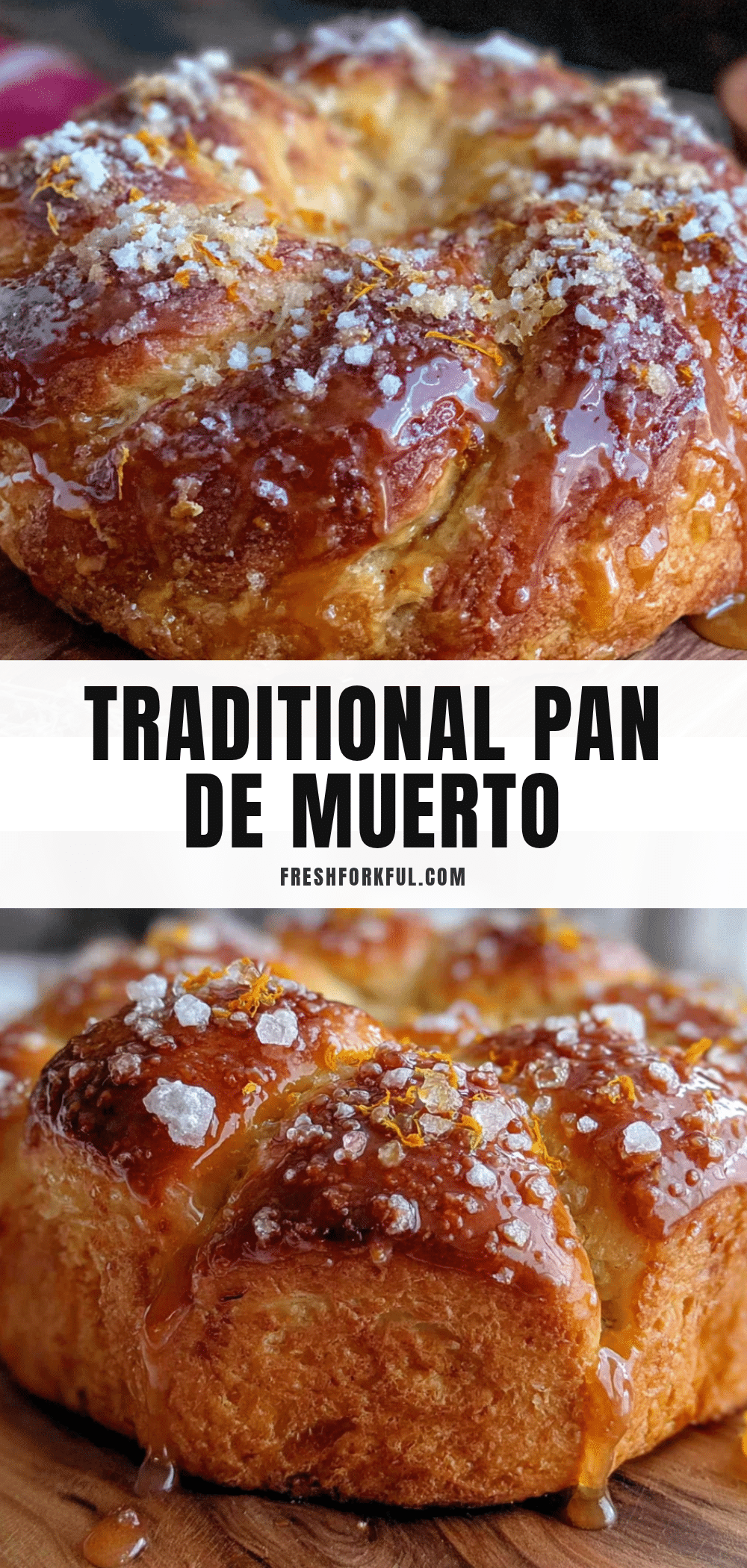
Traditional Pan de Muerto with Easy Orange Blossom Glaze
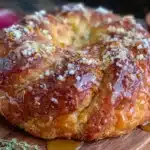
This Pan de Muerto is a soft, aromatic bread with a tender crumb and a floral orange blossom glaze. It comes together in a single afternoon, making it perfect for Día de Muertos or any fall celebration.
- Prep Time: 20 minutes
- Cook Time: 25-30 minutes
- Total Time: 3 hours (including rising time)
- Yield: 8 servings 1x
- Category: Bread
- Cuisine: Mexican
Ingredients
- 3 ½ cups (440g) all-purpose flour
- 2 ¼ teaspoons (one ¼-ounce packet) active dry yeast
- ½ cup (120ml) whole milk, warm (about 110°F)
- ½ cup (100g) granulated sugar
- 6 tablespoons (85g) unsalted butter, softened
- 3 large eggs, room temperature
- 2 tablespoons orange zest (from about 2 large oranges)
- 1 teaspoon vanilla extract
- 1 teaspoon fine sea salt
- For the tangzhong starter: 3 tablespoons (25g) all-purpose flour + ½ cup (120ml) water
- For the orange blossom glaze: 1 cup (120g) powdered sugar, 2 tablespoons orange blossom water, 1 tablespoon fresh orange juice
- For decoration: extra granulated sugar or coarse sanding sugar for sprinkling
Instructions
- Make the tangzhong starter: In a small saucepan, whisk together 3 tablespoons flour and ½ cup water. Cook over medium heat, stirring constantly, until it forms a thick paste (about 2 minutes). Remove from heat and let cool to room temperature.
- Activate the yeast: In a small bowl, combine the warm milk, 1 tablespoon of the sugar, and the yeast. Stir gently and let sit for 5-10 minutes until foamy.
- Mix the dough: In a large bowl, whisk together the remaining sugar, flour, and salt. Add the cooled tangzhong, foamy yeast mixture, eggs, softened butter, orange zest, and vanilla. Stir with a wooden spoon until a shaggy dough forms.
- Knead the dough: Turn the dough out onto a lightly floured surface. Knead for 10-12 minutes (or use a stand mixer with dough hook on medium-low for 8 minutes) until smooth, elastic, and slightly tacky. It should pass the windowpane test.
- First rise: Place the dough in a lightly oiled bowl, turning to coat. Cover tightly with plastic wrap and let rise in a warm spot for 1-1.5 hours until doubled in size.
- Shape the dough: Punch down the dough gently. Cut off about ¼ of the dough and set aside. Shape the larger piece into a round ball and place on a parchment-lined baking sheet.
- Form the bones and top piece: Divide the reserved dough into 4 equal pieces for the ‘bones’ and 1 small piece for the top knob. Roll each of the 4 pieces into ropes about 6 inches long. Place them on top of the round loaf in a cross pattern. Roll the small piece into a ball and place it in the center where the ropes cross.
- Second rise: Cover the shaped loaf loosely with a clean towel and let rise for 45 minutes to 1 hour until puffy and almost doubled.
- Preheat and bake: About 20 minutes before the second rise is done, preheat oven to 350°F (175°C). Bake the bread for 25-30 minutes until golden brown and internal temperature reaches 190°F (88°C). Tent with foil after 15 minutes if browning too fast.
- Make the glaze: While the bread cools, whisk together powdered sugar, orange blossom water, and orange juice until smooth. Adjust consistency as needed.
- Glaze and serve: Let the bread cool on the baking sheet for 10 minutes, then transfer to a cooling rack. While still warm, brush the glaze generously over the top. Sprinkle with sanding sugar immediately. Let glaze set for 10 minutes before slicing.
Notes
Don’t skip the tangzhong starter; it keeps the bread soft for days. Use a kitchen scale for accurate flour measurement. Let the bread cool to warm before glazing so the glaze sticks. The bread is best served warm but also great at room temperature.
Nutrition
- Serving Size: 1/8 of the loaf
- Calories: 320
- Sugar: 18
- Sodium: 200
- Fat: 12
- Saturated Fat: 7
- Carbohydrates: 48
- Fiber: 2
- Protein: 6
Keywords: Pan de Muerto, Day of the Dead bread, orange blossom glaze, Mexican sweet bread, traditional bread, Día de Muertos