Love this? Save it for later!
Share the inspiration with your friends
My neighbor wasn’t trying to impress anyone. I’d stopped by to return her tupperware—the good ones with the snap lids that I’d accidentally kept for three weeks—and the smell hit me before I even got past her screen door. It was savory and sweet, a little bit garlicky, and it made my stomach growl so loud I hoped she couldn’t hear it through the screen.
“What is that?” I asked before I even said hello.
She glanced back at her kitchen like she’d almost forgotten something was on the stove. “Oh, just eggs.” Just eggs. She said it the way someone might say “I grabbed a glass of water.” But the way she shrugged her shoulders and waved her hand—like it was nothing—made me want to grab her by the apron and demand the full story.
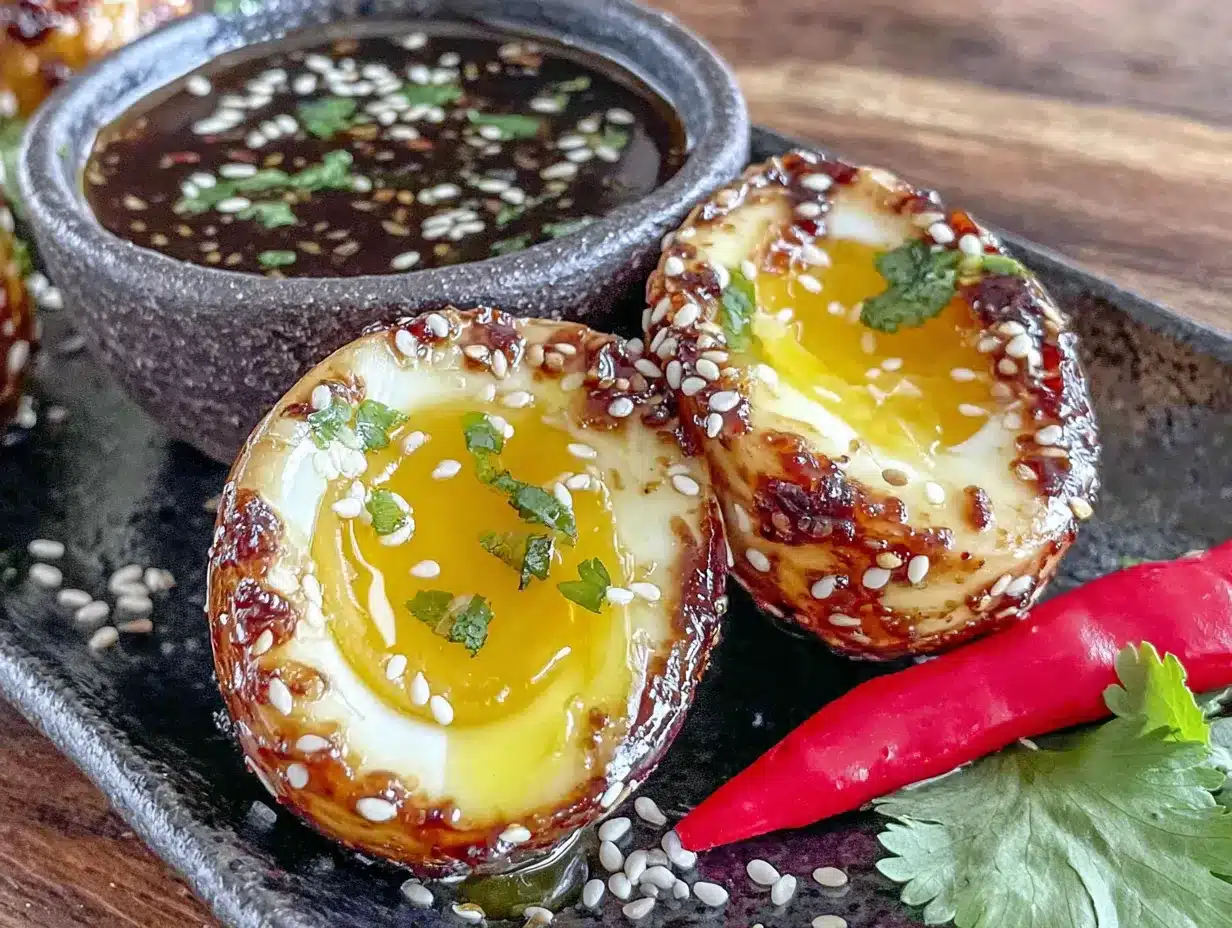
Turns out, she was making Korean soy sauce marinated eggs. Mayak eggs, she called them. “Mayak” means “narcotic” in Korean, she explained with a little laugh, because they’re so addictive you can’t stop eating them. And honestly? The name fits. I stood there in her kitchen, holding that plastic tupperware, watching her peel a dozen jammy eggs like it was the most ordinary Tuesday on earth. She let me try one—just one, she warned—and I closed my eyes for a second. The yolk was soft and rich, the marinade had soaked into the whites just enough, and there was this little kick of sesame and chili that made me want another bite immediately.
She ended up sending me home with four of them in a jar. I ate two before I even got to my car.
Since that day, I’ve made these Korean soy sauce marinated eggs more times than I can count. They’ve become my secret weapon for busy weeknights, lunch prep, and honestly, any time I need something that feels special without a lot of effort. Maybe you’ve been there—staring into your fridge at 6 PM with no plan and a hungry family. These eggs are the answer you didn’t know you needed.
Why You’ll Love This Recipe
Let me tell you why these Korean soy sauce marinated eggs have become a staple in my house. I’ve tested this recipe at least a dozen times—changing the ratio of soy sauce to water, adjusting the sugar, trying different boiling times—and I can say with confidence that this version is the one.
- Quick & Easy: These come together in about 15 minutes of active time. The hardest part is peeling the eggs, and I’ll share my trick for that below.
- Simple Ingredients: You probably have soy sauce, sugar, and garlic in your kitchen right now. No fancy grocery trips needed.
- Perfect for Family Meals: These eggs are a lifesaver on busy nights. Serve them over rice with a quick vegetable on the side, and dinner is done.
- Crowd-Pleaser: I’ve served these to kids, picky eaters, and adults who “don’t like eggs.” They disappear every single time.
- Unbelievably Delicious: The combination of savory soy, sweet mirin, and jammy yolk is next-level comfort food. It’s the kind of thing you’ll crave at random hours.
What makes these Korean soy sauce marinated eggs different from other versions? It’s the balance. Some recipes are too salty or too sweet. This one hits that perfect middle ground where every flavor works together. Plus, the texture of the egg—firm whites with a soft, almost creamy yolk—makes every bite worth savoring.
These eggs aren’t just good. They’re the kind that make you close your eyes after the first bite. It’s comfort food reimagined—simpler, faster, but with the same soul-soothing satisfaction. Perfect for impressing your family without stress, or turning a simple bowl of rice into something memorable.
What Ingredients You Will Need
This Korean soy sauce marinated eggs recipe uses simple, everyday ingredients to deliver bold flavor and satisfying texture without the fuss. Most of these are pantry staples, which is exactly what you want when you’re feeding a family on a budget.
For the Eggs
- 6 large eggs (room temperature works best for even cooking)
- Ice water bath (for stopping the cooking process)
For the Marinade
- 1/2 cup soy sauce (I prefer Kikkoman or a low-sodium brand for better control)
- 1/2 cup water
- 3 tablespoons brown sugar (light or dark both work; dark gives a deeper flavor)
- 2 tablespoons mirin (or substitute with 1 tablespoon rice vinegar + 1 teaspoon sugar)
- 4 cloves garlic, minced (use fresh, not jarred—it makes a difference)
- 1 small onion, thinly sliced (yellow or sweet onion works best)
- 1 tablespoon sesame oil
- 1 teaspoon sesame seeds (toasted if you have them)
- 1-2 green onions, chopped (for garnish)
- Optional: 1/2 teaspoon red pepper flakes or 1 fresh red chili, sliced (for a little kick—kids might prefer without)
A few notes on ingredients: The brown sugar is key here. It balances the saltiness of the soy sauce and gives the marinade a nice richness. If you’re watching sugar intake, you can reduce it to 2 tablespoons, but I wouldn’t go lower than that. The mirin adds a subtle sweetness and depth that you can’t quite replicate, but the substitute works in a pinch.
For the eggs, I recommend using large eggs from a brand you trust. Farm-fresh eggs are amazing, but they’re harder to peel when they’re super fresh. If you’re using very fresh eggs, add a splash of vinegar to the boiling water—it helps the whites set faster and makes peeling easier. I learned that trick after a particularly frustrating peeling session, and it’s been a game-changer.
If you need a gluten-free option, use tamari instead of soy sauce. Coconut aminos also work, but the flavor will be slightly different—sweeter and less salty. Adjust the sugar down a bit if you go that route.
Equipment Needed
You don’t need much for these Korean soy sauce marinated eggs, which is part of the beauty. Here’s what you’ll want:
- Medium saucepan (for boiling the eggs)
- Bowl for ice water bath (a large mixing bowl works fine)
- Small bowl or jar (for mixing and storing the marinade)
- Whisk or fork (for mixing the marinade)
- Measuring cups and spoons
- Knife and cutting board (for garlic, onion, and green onions)
- Slotted spoon (for transferring eggs)
If you don’t have a slotted spoon, a regular spoon works—just be gentle with the eggs. I’ve also used tongs in a pinch, but they can sometimes crack the whites if you’re not careful. A simple colander works for the ice bath step.
For storing, a glass jar with a tight-fitting lid is ideal. I use a 32-ounce mason jar, and it fits 6 eggs with the marinade perfectly. If you don’t have a jar, a small bowl with plastic wrap works, but the eggs need to be fully submerged, so keep that in mind.
One tip: If you’re making a double batch (which I often do), you’ll need a larger container. A rectangular glass dish works well—just make sure the eggs are in a single layer and covered with marinade.
Preparation Method
Making these Korean soy sauce marinated eggs is straightforward, but a few details make all the difference. Follow these steps, and you’ll have perfect eggs every time.
Step 1: Prepare the Ice Bath
Fill a medium bowl with cold water and add a handful of ice cubes. Set it aside near the stove. This is crucial for stopping the cooking process and getting that perfect jammy yolk.
Step 2: Boil the Eggs
Bring a medium saucepan of water to a rolling boil. Gently lower the eggs into the water using a slotted spoon to avoid cracking. Set a timer for exactly 6 minutes and 30 seconds for jammy yolks. If you prefer a slightly firmer yolk, go for 7 minutes. For a fully hard-boiled egg, cook for 9 minutes, but honestly, the jammy texture is what makes these eggs special.
Pro tip: If your eggs are straight from the fridge, add 30 seconds to the cooking time. Room temperature eggs cook more evenly, so take them out of the fridge 10 minutes before you start.
Step 3: Shock the Eggs
As soon as the timer goes off, use the slotted spoon to transfer the eggs to the ice bath. Let them sit for at least 5 minutes. This stops the cooking immediately and makes peeling much easier. I’ve skipped this step before out of impatience, and I regretted it—the yolks kept cooking and ended up too firm.
Step 4: Make the Marinade
While the eggs are cooling, make the marinade. In a small bowl or measuring cup, combine the soy sauce, water, brown sugar, mirin, minced garlic, and sliced onion. Whisk until the sugar is mostly dissolved. If you’re using red pepper flakes or chili, add them now. Set the marinade aside.
Step 5: Peel the Eggs
Gently tap each egg on the counter to crack the shell, then roll it between your palms to loosen the shell. Start peeling from the wider end—there’s usually an air pocket that makes it easier to get under the membrane. Rinse the peeled eggs under cold water to remove any tiny shell fragments.
Here’s my trick for easy peeling: Peel the eggs under a thin stream of running water. The water helps separate the membrane from the egg white, and any stubborn shell pieces wash away. This method has saved me so many mangled eggs.
Step 6: Combine and Marinate
Place the peeled eggs in a jar or container. Pour the marinade over them, making sure they’re fully submerged. If they float to the top, place a small lid or a piece of plastic wrap directly on the surface to keep them under the liquid. Add the sesame oil and sprinkle the sesame seeds on top.
Step 7: Refrigerate and Wait
Cover the container and refrigerate for at least 4 hours, but overnight is best. The eggs will continue to absorb the marinade, and the flavor deepens over time. I usually make these the night before I plan to serve them.
After 24 hours, the whites will have a beautiful amber color from the soy sauce, and the flavor will be perfectly balanced—savory, sweet, and a little garlicky. Don’t let them marinate longer than 3 days, or they can get too salty.
Cooking Tips & Techniques
After making these Korean soy sauce marinated eggs more times than I can count, I’ve picked up a few tricks that make the process smoother and the results better.
Perfect timing is everything. The difference between a jammy yolk and a hard yolk is about 30 seconds. I set my timer for 6 minutes 30 seconds and don’t mess with it. If you’re cooking at high altitude, add 30 seconds to a minute—water boils at a lower temperature up there, so eggs take slightly longer to cook.
Don’t skip the ice bath. I know it’s tempting to just run the eggs under cold water, but the ice bath stops the cooking instantly. Without it, the residual heat continues cooking the yolk, and you’ll end up with a firmer texture than you wanted. I learned this the hard way when I was rushing one morning and ended up with fully hard-boiled yolks instead of jammy ones.
Peel strategically. Older eggs peel more easily than fresh ones. If your eggs are very fresh (less than a week old), add a teaspoon of baking soda to the boiling water. The alkaline water helps loosen the membrane from the egg white. Also, cracking the shell all over before peeling—like making a mosaic of cracks—makes the shell come off in bigger pieces.
Adjust the marinade to your taste. Some people like their eggs saltier, some prefer sweeter. Taste the marinade before you pour it over the eggs. If it’s too salty for your liking, add a tablespoon more water. If you want it sweeter, add a little more brown sugar. Trust your palate—you’re the one eating them.
Multitask wisely. While the eggs are boiling and then cooling, you can prep the marinade ingredients. This way, everything comes together in about 15 minutes. I usually mince the garlic and slice the onion while the eggs are in the ice bath, then mix the marinade while I’m peeling the eggs.
One mistake I made early on: I used too small a container and the eggs weren’t fully submerged. The tops stayed white while the bottoms turned brown. It looked strange and the flavor was uneven. Now I always use a container that fits the eggs in a single layer with enough marinade to cover them completely.
Variations & Adaptations
These Korean soy sauce marinated eggs are incredibly versatile. Here are some ways to change them up based on what you have or who you’re feeding.
Spicy Version
Add 1 tablespoon of gochugaru (Korean red pepper flakes) or 1 teaspoon of gochujang (Korean chili paste) to the marinade. This gives the eggs a warm, complex heat that builds slowly. My husband loves this version, but I keep it separate for the kids who prefer the milder original.
Low-Sugar Version
Replace the brown sugar with 2 tablespoons of honey or maple syrup. The flavor will be slightly different—a little more floral—but still delicious. You can also use a sugar substitute like monk fruit sweetener, but start with less and adjust to taste.
Garlic-Lover’s Version
Double the garlic. I mean it—use 8 cloves instead of 4. The garlic mellows as it marinates, so it won’t be overpowering. It just adds a deeper, more complex flavor that garlic fans will appreciate.
Add-In Ideas
Try adding a sheet of dried kelp (dashima) to the marinade for a subtle umami boost. Or throw in a few slices of ginger for a bright, slightly spicy note. I’ve also added a splash of rice vinegar when I wanted a tangier marinade, and it worked beautifully.
Dietary Adaptations
For a gluten-free version, swap the soy sauce for tamari or coconut aminos. For a vegan version, this recipe doesn’t work with eggs, but you could try the marinade on cubed tofu—let it sit for at least 2 hours for the flavors to absorb.
I once tried adding a star anise to the marinade because I was out of garlic and thought it might add depth. It did—but in a very licorice-forward way that my kids did not appreciate. Stick to the original unless you’re sure everyone’s on board with that flavor profile.
Serving & Storage Suggestions
These Korean soy sauce marinated eggs are incredibly versatile when it comes to serving. Here’s how I use them in my house.
Over Rice: The most classic way to serve these eggs is over a bowl of steamed white rice. Add a drizzle of the marinade, a sprinkle of sesame seeds, and some chopped green onions. It’s a complete meal in a bowl. My kids love this for lunch—it’s fast, filling, and they think it’s a treat.
In Noodles: Slice the eggs in half and place them on top of a bowl of ramen or cold noodles. The jammy yolk mixes with the broth and makes everything richer. I’ve also added them to leftover lo mein for a quick upgrade.
On Toast: For a quick breakfast or snack, mash one egg on a piece of toasted sourdough. Add a little butter and a sprinkle of flaky salt. It’s simple but so satisfying.
As a Snack: Honestly, I eat these straight out of the jar sometimes. They’re that good. Just grab one, take a bite, and go about your day. They’re protein-packed and satisfying.
Storage: Keep the eggs in the marinade in a sealed container in the refrigerator. They’ll stay good for up to 5 days, but the flavor is best between 24 hours and 3 days. After that, the eggs can become too salty and the texture starts to change slightly.
Reheating: These eggs are typically served cold or at room temperature, but if you prefer them warm, place them in a bowl and pour a little hot water over them for 30 seconds. Don’t microwave them—the yolk can explode and the texture gets rubbery.
Flavor Development: The eggs continue to absorb the marinade over time. After 24 hours, they’re perfectly seasoned. After 48 hours, they’re more intense. I like to make a batch and eat them over a few days, enjoying how the flavor deepens.
Nutritional Information & Benefits
These Korean soy sauce marinated eggs are packed with protein and healthy fats, making them a great option for balanced meals. Here’s a rough estimate per egg (based on the marinade ingredients divided by 6 servings):
| Nutrient | Amount per Egg |
|---|---|
| Calories | ~120 |
| Protein | 7g |
| Fat | 6g |
| Carbohydrates | 8g |
| Sugar | 6g |
| Sodium | 650mg |
Eggs are a fantastic source of high-quality protein, vitamin B12, and choline, which supports brain health. The garlic and onion in the marinade add antioxidants and anti-inflammatory properties. If you’re watching your sodium intake, use low-sodium soy sauce or reduce the marinating time to 2-3 hours.
These eggs are naturally gluten-free if you use tamari, and they’re low-carb friendly. They fit into most dietary patterns—paleo, keto, and whole30 all work with minor adjustments. Just be mindful of the sugar content if you’re on a strict low-carb diet.
I love that these eggs give my family a protein boost without a lot of fuss. They’re a great option for busy mornings or post-school snacks when the kids need something substantial but quick.
Conclusion
These Korean soy sauce marinated eggs have earned a permanent spot in my refrigerator rotation. They’re simple enough for a Tuesday night but special enough that guests always ask for the recipe. The best part? They cost pennies to make, use ingredients you probably already have, and somehow feel like a treat every single time.
I encourage you to make these your own. Adjust the sweetness, add some heat, or throw in extra garlic. That’s the beauty of a simple recipe—it’s a starting point, not a rulebook. The first time you pull a jar of these amber-colored eggs out of the fridge and watch your family’s eyes light up, you’ll understand why I can’t stop making them.
If you give these a try, I’d love to hear how they turned out. Leave a comment below and let me know if your family loved them as much as mine does. And if you come up with a fun variation, share that too—I’m always looking for new ideas to try!
Frequently Asked Questions
Can I use brown eggs instead of white eggs?
Absolutely. The color of the shell doesn’t affect the taste or texture. Use whichever you have on hand. Just note that some brown eggs have slightly thicker shells, so they might take an extra 15-20 seconds to cook to the same doneness.
How long do these eggs last in the fridge?
They’ll stay good for up to 5 days in the refrigerator, stored in the marinade in a sealed container. The flavor is best between 24 hours and 3 days. After that, they can become quite salty as they continue to absorb the marinade.
Can I reuse the marinade?
I don’t recommend reusing the marinade for a second batch of eggs. The first batch absorbs a lot of the flavor, and the marinade also picks up some egg residue. It’s better to make a fresh batch. However, you can use leftover marinade as a quick sauce for rice or vegetables—just boil it first to be safe.
My eggs were hard to peel. What did I do wrong?
This usually happens with very fresh eggs. The membrane is still tightly attached to the shell. Next time, try using eggs that are at least a week old, or add a teaspoon of baking soda to the boiling water. Also, make sure you’re shocking them in an ice bath immediately after boiling—this helps separate the membrane from the egg white.
Can I make these with soft-boiled eggs instead of jammy?
Yes! For a softer, runnier yolk, cook the eggs for exactly 6 minutes. Be extra careful when peeling because the yolk is very liquid. The marinade will still work beautifully, and the runny yolk mixing with the soy sauce is absolutely delicious over rice.
Pin This Recipe!

Perfect Easy 15-Minute Mayak Eggs: Kid-Approved

These Korean soy sauce marinated eggs (Mayak eggs) are savory, sweet, and garlicky with a jammy yolk. Ready in 15 minutes, they’re a quick, family-friendly meal that’s perfect over rice or as a snack.
- Prep Time: 15 minutes
- Cook Time: 7 minutes
- Total Time: 22 minutes (plus 4 hours marinating)
- Yield: 6 servings 1x
- Category: Appetizer
- Cuisine: Korean
Ingredients
- 6 large eggs (room temperature)
- Ice water bath
- 1/2 cup soy sauce (Kikkoman or low-sodium)
- 1/2 cup water
- 3 tablespoons brown sugar (light or dark)
- 2 tablespoons mirin (or 1 tablespoon rice vinegar + 1 teaspoon sugar)
- 4 cloves garlic, minced
- 1 small onion, thinly sliced (yellow or sweet)
- 1 tablespoon sesame oil
- 1 teaspoon sesame seeds (toasted if available)
- 1–2 green onions, chopped (for garnish)
- Optional: 1/2 teaspoon red pepper flakes or 1 fresh red chili, sliced
Instructions
- Prepare the ice bath: Fill a medium bowl with cold water and ice cubes. Set aside near the stove.
- Boil the eggs: Bring a medium saucepan of water to a rolling boil. Gently lower the eggs into the water using a slotted spoon. Cook for exactly 6 minutes 30 seconds for jammy yolks (7 minutes for firmer, 9 minutes for hard-boiled).
- Shock the eggs: Immediately transfer the eggs to the ice bath using the slotted spoon. Let sit for at least 5 minutes to stop cooking.
- Make the marinade: In a small bowl or measuring cup, combine soy sauce, water, brown sugar, mirin, minced garlic, and sliced onion. Whisk until sugar is mostly dissolved. Add red pepper flakes or chili if using.
- Peel the eggs: Gently tap each egg on the counter to crack the shell, then roll between palms to loosen. Start peeling from the wider end. Rinse under cold water to remove shell fragments. For easier peeling, peel under running water.
- Combine and marinate: Place peeled eggs in a jar or container. Pour marinade over them, ensuring they are fully submerged. Add sesame oil and sprinkle sesame seeds on top. If eggs float, place a small lid or plastic wrap directly on the surface to keep them submerged.
- Refrigerate and wait: Cover and refrigerate for at least 4 hours, preferably overnight. The eggs will continue to absorb the marinade. Best flavor between 24 hours and 3 days. Do not marinate longer than 3 days.
Notes
For easy peeling, use eggs that are at least a week old or add a teaspoon of baking soda to the boiling water. The ice bath is crucial for stopping cooking and achieving jammy yolks. Adjust marinade to taste: add more water if too salty, more sugar if too sweet. For gluten-free, use tamari instead of soy sauce. For a spicy version, add gochugaru or gochujang. Store in the refrigerator for up to 5 days; flavor is best between 24 hours and 3 days.
Nutrition
- Serving Size: 1 egg
- Calories: 120
- Sugar: 6
- Sodium: 650
- Fat: 6
- Saturated Fat: 2
- Carbohydrates: 8
- Protein: 7
Keywords: mayak eggs, Korean soy sauce eggs, marinated eggs, jammy eggs, quick eggs, easy eggs, kid-friendly, Korean recipe